

Poarch Creek Indians New Reservation Mural Celebrates Creek Resilience
Share this:
If you’ve driven along Jack Springs Road in the past month, you’ve likely noticed the new mural on Building 100. A big mvto to Wendy Deschene and her students from Auburn University for painting this vibrant work of art. Every part of this colorful collage tells a powerful story about our community.
“We didn’t want to focus on just one moment; we wanted it to show a timeline of our people, where we come from, what we’ve been through and what we still carry forward today.” said Billy Bailey, Poarch Creek Indians Tribal Historic Preservation Officer. “It was important to us that it shows who we are through our lifeways, not through a logo or words. We hope this is something our people can be proud of.”
“Painting this 50-foot mural was an act of gratitude and a way to honor my indigenous ancestors while celebrating the stories of the Poarch Creek Indians and the First Nations of Alabama,” said Wendy DesChene, professor of art and art history at Auburn University.
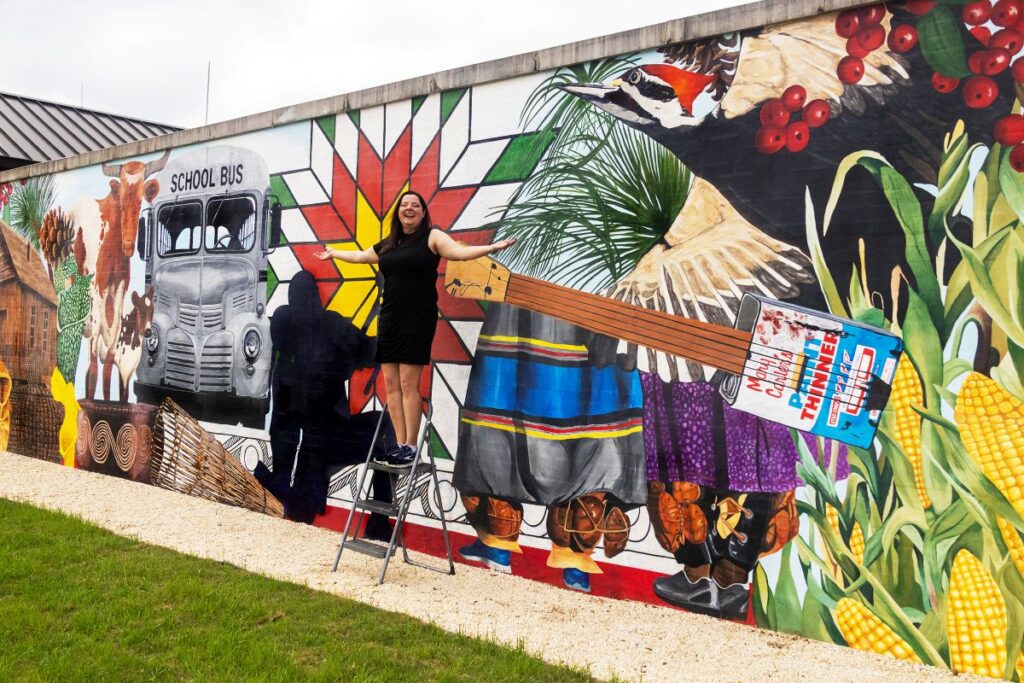
In May, the mural honoring PCI history and culture by Professor Wendy DesChene and her students was installed outside the Poarch Creek Indians’ new administrative building in Atmore, Alabama. Photo credit: John David Carcache.
Traditional cultural arts are woven throughout the mural, from fish trap baskets and quilt patterns to longleaf pine needle baskets, pottery, and pucker-toe moccasins. These are ancient skills our people have worked hard to preserve and revitalize. Turtle shell shakers, worn by stomp dancing women, and a lively stickball game scene speak to practices that continue to bring our people together.
Our agricultural roots are just as visible, with scenes of cattle and corn standing alongside culturally important species, like woodpeckers, longleaf pine, pitcher plants, and yaupon holly, all uniquely part of our homeland’s ecosystems.
There are pieces of local history shown too, for those who know where to look. The importance of education to our people are clearly sign, in landmarks like an old Indian schoolhouse/church, along with a powerful reference to the moment Jack Daughtry stood in the road with his twin daughters to stop a school bus. This brave act helped bring an end to segregation in our local school system.
An imagined portrait of Sehoy McGillivray stands strong to the left, grounding the mural in our ancestral roots. Another detail shows a handmade instrument made by Chippy Rolin, crafted from a can of paint thinner and guitar strings. That very instrument can still be seen today at the Poarch Creek Museum, as a reminder of the difficult times our community endured.
“The Auburn students who worked on this mural created it with the love and care that this kind of story telling deserves. I am so proud of how well our students understood that this painting deserved their best work, and they really gave their hearts to it,” said Wendy.
Next time you’re on the reservation, whether you’re visiting the museum or just passing through, take a moment to stop and experience the mural up close. It’s more than just a work of art. Everything within it represents what the Tribal Historic Preservation Department wants to encourage with their historic preservation and cultural revitalization initiative. It intentionally did not include the Poarch Creek logo, instead choosing to show some of the many pieces of our life that shows who we are as Creek people. It’s a celebration of our history, our resilience, and the many things that make the Poarch Creek community proud.