

Poarch 101: Standing Along the Water — The Unbroken Continuity of Our Lineage
Share this:
By: The Poarch Creek Indians Tribal Historic Preservation Office
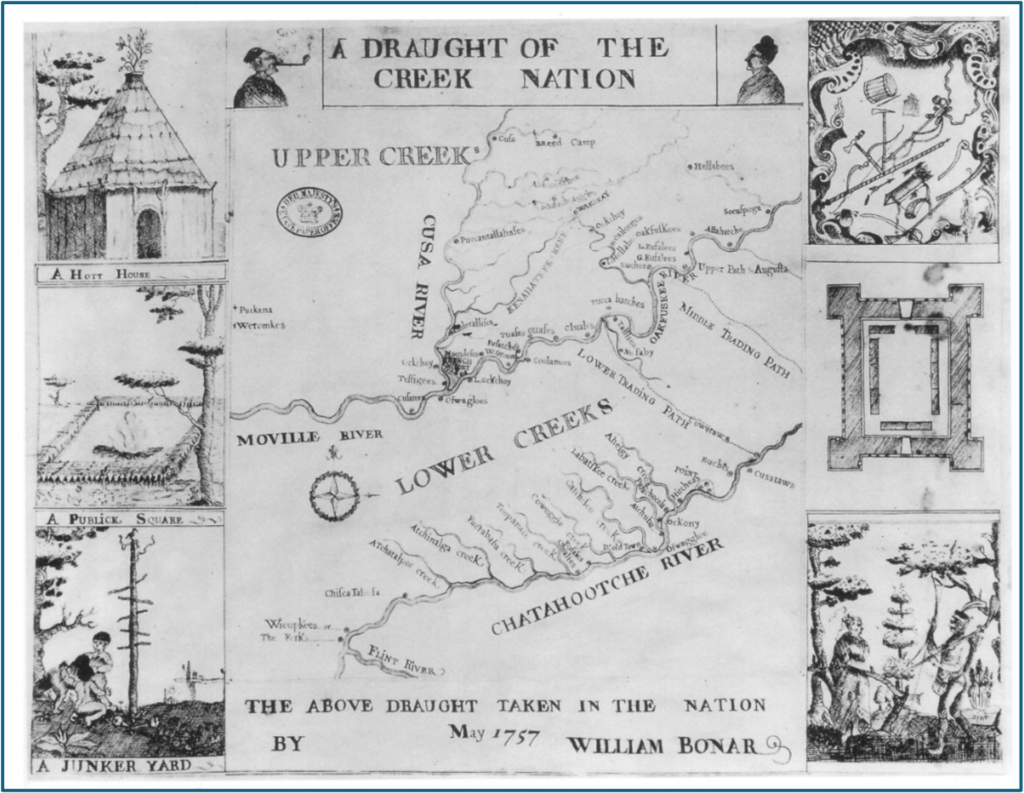
Near Montgomery, the Coosa and Tallapoosa Rivers join to form the Alabama River. This river junction was the epicenter of life for the Alabama and Koasati peoples during the 17th, 18th, and 19th centuries. Tribal towns such as Taskigi, Coosada, Muklassa, Tallassee (or Little Tallassee), Hickory Ground, and others along these rivers were home to our ancestors of that era. This homeland also gave rise to a remarkable line of women whose names form the foundation of our Tribal bloodlines: Sehoy, Sehoy McGillivray, Sehoy Weatherford, Sophia McGillivray (Durant), and Elizabeth Weatherford (Moniac). Through their resilience and perseverance, we were able to remain here in Poarch, Alabama.
This is our glimpse into the women who stood toe-to-toe with colonial America and refused to surrender their mothers’ homelands. Their enduring spirit continues to guide us forward as confident stewards of those same lands.
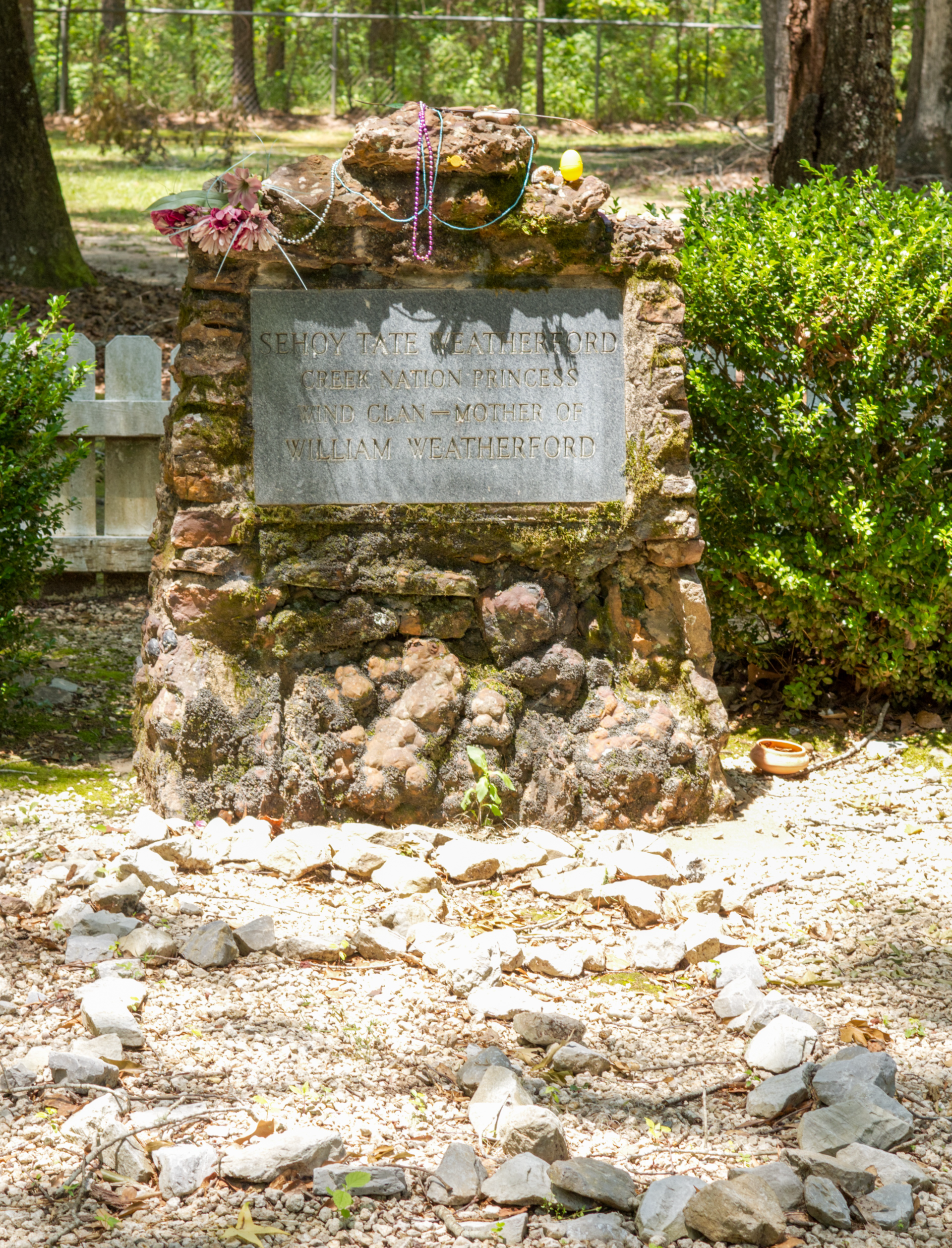
Sehoy — Witness to a World Transformed
Living in the late 1600s and early 1700s, Sehoy belonged to the Wind Clan (Hotvlkvlke), one of the most important clans within Creek society. Her name has been passed down to her descendants for nearly 400 years. Through matrilineal inheritance, her children carried authority and rights over the surrounding lands.
Sehoy’s homelands were those of the Alabama and Koasati, who had long lived at the river confluence before becoming part of the Upper Creek Nation. In the early 1700s, French traders built Fort Toulouse near one of their towns, Taskigi. After the French and Indian War in 1763, English officials and settlers moved into the Fort Toulouse area. With their arrival, many Alabama and Koasati families migrated westward to Louisiana and Texas, while those who remained gradually adopted the language and many customs of the Mvskoke people.
European trade transformed the lives of Native peoples in the region, yet their world was still shaped by the memory of the Mississippian chiefdoms that had once flourished here. According to an Alabama (Alibamu) oral tradition, their ancestors moved northward from the great Bottle Creek Mound complex in the Mobile/Tensaw Delta, a major settlement of that earlier world. Many of Sehoy’s descendants later returned to this homeland, and some still hunt and fish there today. For generations, they have treasured the area as a place deeply tied to identity and memory.
Sehoy may have had more than two children, but only two are known from surviving accounts: a son called Red Shoes and a daughter, Sehoy McGillivray. Records of Native women in the 1700s are scarce, often limited to scattered notes from traders and colonial officials, and much of their lives must be pieced together through oral tradition. This silence in the written record reflects how colonial reporters often overlooked or minimized women’s roles, even though in Creek society some women held significant authority through the matrilineal clan system. Both oral tradition and historical sources affirm Sehoy as the matriarch whose clan rights and ancestral standing gave authority to her children and grandchildren. When she passed away around 1730, she left a foundation for a lineage of Alabama Creeks whose influence would profoundly alter the course of history.
Sehoy McGillivray — Where Two Worlds Became One
Sehoy McGillivray lived during the height of colonial rivalry, when France, Britain, and Spain competed for control of Creek trade alliances from every direction. Her life bridged Tribal traditions and the new pressures of European expansion, securing influence that extended across both Native and colonial worlds.
Oral tradition and most contemporary accounts remembered her as a full-blood Upper Creek woman. Yet her French son-in-law later claimed that her father was French, a story likely crafted to enhance his own standing when petitioning for rank in the French army.
With Scottish trader Lachlan McGillivray, Sehoy had several children, including Alexander, who became the Creek Nation’s principal diplomat and one of the most important Native American leaders of the post-Revolutionary era, as well as Sophia and Jeanette. Through another marriage, she bore a daughter, also named Sehoy, and a son, Malcolm McPherson II, who would later serve as Mekko of Hickory Ground.
Her matrilineal authority allowed her husband and children to reside on lands from the Little Tallassee, north on the Coosa River near Wetumpka, and south to the Mobile/Tensaw Delta. Traders could not simply settle there without Creek consent; it was through marriage to powerful Creek women, such as Sehoy McGillivray, that they gained access to favor. Oral tradition recalls that while pregnant, Sehoy dreamed of piles of manuscripts, a vision seen as a prophecy of her son Alexander’s future as a diplomat and writer.
Though the date of her death is uncertain, her influence endured through her children and descendants, who carried her clan’s authority into the generations that followed. As a matriarch of the Wind, Sehoy McGillivray left a legacy that shaped the course of Creek history during one of its most turbulent eras.
Sophia McGillivray (Durant) — The Woman Who Spoke for a Nation
Sophia McGillivray, later known as Sophia Durant, emerged as a woman of remarkable authority during a time of confusion and transformation. She played a central role in settling Hickory Ground, a new community that grew from Little Tallassee. Visitors frequently remarked on her presence in council, where she often spoke with eloquence and authority on behalf of her brother Alexander. Fluent in multiple languages and respected as the eldest daughter of a Wind Clan matrilineage, she embodied the balance of Creek tradition and leadership in an era of rising colonial pressure.
Her household reflected the blending of Creek, African, and European worlds. At Hickory Ground and Little Tallassee, Creek families and enslaved African Creeks lived side by side. Though Sophia’s household held enslaved people by colonial law, a reality that cannot be overlooked, their lives were not structured under the harsh regime of plantation slavery. European outsiders noted with surprise that Creeks and African Creeks labored communally, celebrated together, and lived in independent cabins, giving the settlement the appearance of a thriving village rather than a plantation. Sophia herself lived in a modest hut, described by observers as poor, and some criticized her for refusing to exploit enslaved labor to elevate her status. Later descendants, such as David Tate, would educate and even free enslaved people decades before Emancipation, continuing this complex relationship to bondage within the Sehoy line.
Sophia married Benjamin Durant, a man of both Native and African descent, and together they raised at least six children. Her role as a mother did not diminish her influence in public life. In 1790, while her brother Alexander was in New York negotiating a treaty with President George Washington, Creeks threatened to attack nearby settlers in the Tensaw. Despite being eight months pregnant, Sophia rode more than 150 miles on horseback from Little River to Hickory Ground. There, she confronted the chiefs, secured the arrest of the ringleaders, and prevented bloodshed. Only two weeks later, she gave birth to twins at Hickory Ground. When Alexander died in Pensacola in 1793, Sophia once again exercised her authority. Rejecting the claims of his Scottish relatives, she ensured that his remains were returned to ancestral ground between the Alabama and Tombigbee Rivers. More than a decade earlier, she and Alexander had been entrusted with strengthening and stabilizing Creek communities in the Tensaw area near Choctaw Bluff, reinforcing them as barriers against European encroachment and as bases for Creek trade at Mobile and Pensacola.
Sophia’s authority continued to expand into the next century. In 1802, Mvskoke and Alabama headmen confirmed her rights to a vast territory stretching between the Alabama and Escambia/Conecuh rivers, ensuring her authority was formally documented so that Creek matrilineal power would also be recognized in colonial law. The southwestern corner of this domain lay in the Tensaw area at the mouth of Holley Creek. Under the 1765 treaty, it had once extended 12 miles farther south to Rice Creek, but after Alexander’s death, steady encroachment over the next 37 years pushed the Creek boundary northward to Holley Creek. It was at this point that the Federal Road reached the Alabama River, where travelers crossed at Mimms Ferry.
Even in the face of these troubles, Sophia Durant’s leadership endured. Her life stands as a testament to resilience, diplomacy, and strength during one of the most difficult and defining eras in Creek history.
Sehoy Weatherford — The Matriarchal Trader
Sehoy Weatherford, sister of Sophia, lived in the midto-late 1700s, when Creek country faced mounting colonial pressures. Oral traditions differ on whether her father was Scottish trader Angus McPherson or a leader from the Tuckabatchee Tribal town
At the age of eight, she entered the household of Jacob Moniac, father of her future son-in-law Sam Moniac, possibly after the death of her mother. From her first marriage she bore Eloise and David Tate. In her second marriage, to Charles Weatherford, a trader of Creek and European descent, she had five children, including Elizabeth Weatherford and William Weatherford, remembered among his people as “Truth Teller” (Oponvkv-fvccv-hayv). William later rose to prominence as the leader of the Red Stick faction during the Creek War. After his death, his legacy was romanticized in Alexander Meek’s 1855 poem The Red Eagle: A Poem of the South, but he was never called Red Eagle in his lifetime.
Sehoy Weatherford’s life reflects the authority Creek women held in trade and clan inheritance. She carried on trading for much of her adult life, even after separating from Charles Weatherford, who remained at Coosada. Contemporary records confirm her role as a trader, while oral traditions and written accounts connect her lineage to Little Tallassee, Hickory Ground, Taskigi, Coosada, Tuckabatchee and the Tensaw, demonstrating the mobility of Creek families who moved fluidly between towns across their ancestral homelands.
In 1799, she inherited the property of her brother Malcolm, Mekko of Hickory Ground, in accordance with matrilineal custom. Sehoy Weatherford died around 1813, just as her son William emerged as a Red Stick leader in the Creek War. She and William were buried in Baldwin County, where their graves remain memorialized today; reminders of a family whose influence shaped Creek history, not far from where her brother Alexander was laid to rest at Choctaw Bluff.
Elizabeth “Betsy” Weatherford (Moniac) — Rooted Through the Storm
Born in 1779, Elizabeth was the daughter of Sehoy Weatherford and the wife of Samuel Moniac, remembered as “Old Man Sam.” While many families were forced to leave after the Creek War of 1813–1814 and during the Indian Removal Act of 1830, Elizabeth remained.
Sam Moniac, a signatory for Little Tallassee at the Treaty of New York, married Elizabeth in the late 1700s. In 1808, they opened a tavern that became a gathering place in the years leading up to the Creek War, until it was destroyed in the conflict. Their household, located 10 miles up the Alabama River from the Holy Ground, embodied the deep divisions of that war. Sam, often accused of siding with U.S. forces, refused to join the Red Sticks, while their son Alexander Dixon fought as a Red Stick warrior. Another son, David Moniac, became the first Native American graduate of West Point at the age of 22 before dying in the Second Seminole War.
Sam’s loyalties were contested even among U.S. troops. At a court of inquiry, he was blamed for misleading soldiers through the swamps as a scout during the Battle of Holy Ground. Later, he died in Pass Christian while traveling with the sixth detachment of the Creek Removal.
Their son, Dixon, attempted to emigrate west but was stopped at gunpoint by Big Warrior’s son, Tuskenehaw. Dixon’s marriage to Elizabeth “Betsy” Elhert of Muklassa, from whom many families of today’s Poarch Creek communities trace their ancestral heritage. Elizabeth and Sam’s daughter, Levitia Moniac, married William Sizemore, another ancestor of the Poarch Creek families.
Elizabeth is likely buried at Judson Indian Cemetery in Poarch, Alabama, in one of the many unmarked graves. After Sam’s death, she lived with her daughter-in-law, Betsy Moniac, whose marked headstone still stands at Judson. Through turmoil, division, and the diminishing of Creek homelands, Elizabeth Weatherford Moniac endured. She never left the land of her mother and grandmothers. Through her, the Sehoy lineage survived and remained rooted on what was reduced to less than 640 acres of ancestral ground, despite cessions, betrayals, removals, and even civil war within families; she remained.
Our Continuity, Our Charge
Sehoy, Sehoy McGillivray, Sehoy Weatherford, Sophia McGillivray, and Elizabeth Weatherford remind us that Creek history is not only about wars and treaties, but also about the mothers, grandmothers, and daughters who grounded their people to their land. Across centuries of struggle and change, from colonialism to the Creek War and Indian Removal, they carried forward their authority, land, and matrilineal traditions. Their leadership was central to the survival of Creek families, binding us forever to the Coosa, Tallapoosa, Alabama, and Escambia/ Conecuh Rivers. Their story flows on in us, as it always has and always will.