

Origin of the Forgotten Creeks: From Alabama to Poarch Band
Share this:
Long before European contact, the Mississippian mound-building culture flourished across what is now Alabama. One of its greatest cities, Moundville, rose along the Black Warrior River by A.D. 1050 and reached its height around 1300. When Moundville declined a century later, archaeological evidence suggests that many of its people migrated south toward the Upper Alabama River. This movement is traced through distinctive ceramic traditions, linking late-phase Moundville pottery to a newer style known as the Big Eddy Phase.
The most prominent Big Eddy community developed at the mound site within present-day Fort Toulouse Park, located at the confluence of the Coosa and Tallapoosa Rivers where the Alabama River begins. Related ceramic styles extended downstream into the lower Tallapoosa region, while upstream influences shifted toward the Shine II complex derived from the Lamar culture of Georgia, which has only limited relevance to Poarch Creek heritage.
As Moundville declined, another major Mississippian center—Bottle Creek—rose in the Mobile-Tensaw Delta. Built on islands south of modern Mobile, Bottle Creek flourished between A.D. 1250 and 1500 as a political and ceremonial hub. Archaeological evidence reveals strong connections between Bottle Creek and Moundville, including shared pottery styles, architectural forms, tools, and even plant and animal remains. The discovery at Bottle Creek of snail species native only to the Black Warrior River basin demonstrates regular movement of people and materials between these two centers.
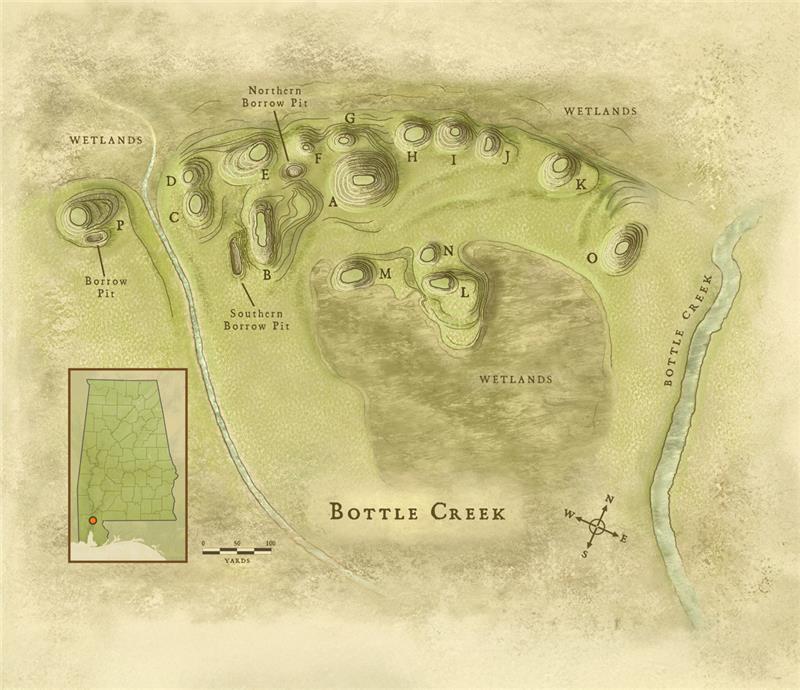
Over time, Moundville-derived traditions at Bottle Creek evolved into what archaeologists call the Pensacola Culture, with traces extending north along the Alabama River. By the 1500s, both Moundville and Bottle Creek were in decline, and their descendants increasingly lived in smaller, dispersed communities. Archaeologists refer to the period from roughly A.D. 1550 to 1650 as the Protohistoric era—a transitional time between mound-building societies and sustained European contact.
During this era, a distinct Burial Urn tradition emerged along the Alabama River, in which families buried loved ones in large clay vessels. These communities blended coastal and inland lifeways and formed an interconnected network extending from the Mobile Delta to the Coosa–Tallapoosa confluence. Spanish records from Hernando de Soto’s 1540 expedition identify this region as the Province of Tuskaloosa.
Following Spanish contact, epidemic disease and warfare reshaped the Southeast. By the 1600s, the Tuskaloosa chiefdom fragmented. Some descendants moved north and became known as the Alabama (Alibamu), eventually absorbed into the Upper Creeks. Others moved south and were identified by the French as Mobilians. In the early eighteenth century, displaced groups such as the Koasati and Tuskegee migrated south due to the Indian slave trade, settling among Alibamu towns and forming new alliances through intermarriage.
By the early 1700s, the Alibamu had become part of the broader Creek Nation, adopting Mvskoke as a shared political language while maintaining distinct traditions. Trader James Adair described the remarkable diversity near the Alabama River, noting that within a small area lived the remnants of several Indian nations, each retaining its own dialect while communicating through Mvskoke.
Native historian George Stiggins later described Alibamu settlements extending along the entire Alabama River, from the Mobile Delta north to the Coosa–Tallapoosa confluence. He emphasized that other tribes encountered the Alibamu already established there and named the river Alabama in recognition of their antiquity. One important Alibamu settlement near the river’s headwaters was Hvcce Fvske (“River Point”), near present-day Parker Island, where Little Tallassee emerged under the leadership of Sehoy McGillivray and her descendants. Hickory Ground later became one of the most influential Upper Creek towns.
An oral history recorded in the late nineteenth century recounts the Alibamu origin near the Alabama River close to Choctaw Bluff (Holsifa). The account lists the ancient Alabama towns and emphasizes their deep connection to the river. Although some scholars later suggested the Sehoy lineage was Koasati, family records, oral traditions, and geographic continuity clearly identify an Alibamu origin. The Sehoy descendants continued returning to the Choctaw Bluff area to bury their dead, reinforcing ancestral ties to that homeland.
Ward Coachman, a descendant of the Sehoy line through his mother Polly Durant, traced his lineage directly to Sehoy McGillivray of the Wind Clan. Through this maternal line, nearly all Poarch Creek families today trace descent, alongside many other Creek lineages. Ward honored this legacy by naming his own daughter Sehoy.
After the death of Alexander McGillivray in 1793, his sister Sophia Durant refused to allow his remains to be sent to Scotland, instead reburying him on their maternal lands near Choctaw Bluff. Creek leaders formalized Sophia’s custodianship of these ancestral lands through a legal indenture recognizing her and her heirs.
The Creek War of 1813–1814 deeply divided Creek families. Sophia’s husband, Benjamin Durant, was killed at Fort Mims, while several of her children joined the Red Stick resistance under their cousin William Weatherford. Around this time, Sophia’s sister Sehoy Weatherford III passed and was buried near the Little River, close to Alexander McGillivray’s grave. Despite the war’s outcome, no known Poarch Creek ancestor signed the Treaty of Fort Jackson or agreed to its land cessions.
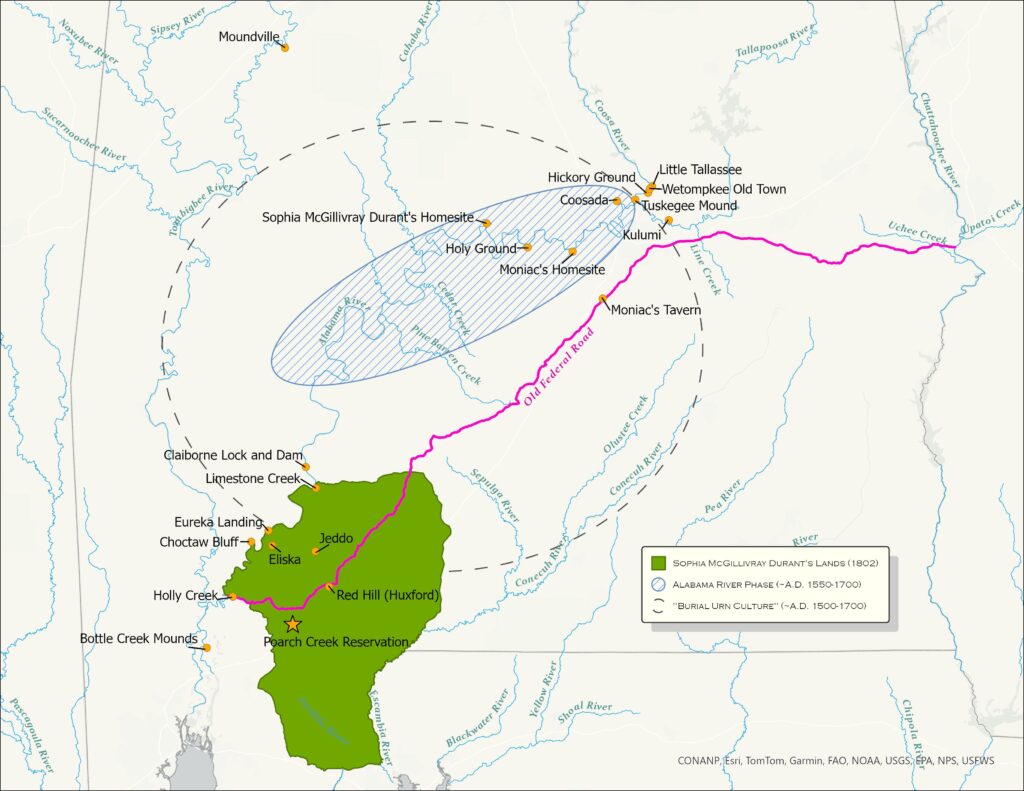
Although the treaty allowed some “friendly Creeks” to retain land, many waited decades for deeds, and others never received them. Even when land was granted, squatters and speculators often forced families off valuable riverfront property, pushing them into the interior longleaf pine savannah where cattle grazing became central to survival. Former Red Stick families intermarried with relatives who held land claims, reuniting kin once divided by war.
Another often overlooked consequence of the Creek War was the fate of orphaned children. American militias frequently enslaved Creek children instead of returning them to their communities. Oral histories suggest that Poarch Creek families rescued and absorbed many of these children, which helps explain their later appearance within Creek households in census records.
In 1848, Ward Coachman returned to Alabama to help relatives relocate west but encountered resistance from would-be slaveholders. At Eureka (Sizemore) Landing near Choctaw Bluff, Levitia “Vicey” Moniac operated a ferry with her husband, connecting families at the heart of their ancestral homeland. Some relatives chose removal, while others—including Elizabeth Weatherford and Vicey—remained near the graves of their ancestors.
Many who stayed gathered around the Tensaw and interior communities, maintaining kinship and cultural continuity. Some who went west later returned, rejoining family members who successfully secured land and preserved Creek heritage within a reduced homeland.
The story of the Poarch Creek people is one of endurance, return, and continuity. From the mound builders of Moundville and Bottle Creek to the Alibamu communities along the Alabama River, our ancestors sustained a heritage spanning more than a thousand years. Despite war, removal, and forced division, they preserved kinship, memory, and identity. The descendants of the Sehoys, Durants, Weatherfords, and countless others who refused to abandon their homelands would become the Poarch Band of Creek Indians—the living continuation of the ancient Alabama River peoples who never forgot who they were, nor where they came from.